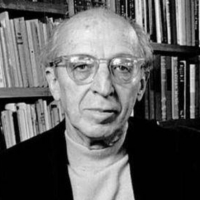
Aaron Copland
Composer · 1900–1990 · American
The composer who gave American orchestras their open, wide-sky sound
In short
Aaron Copland was an American composer whose ballets and orchestral works became the sound most people associate with the American landscape and pioneer spirit, all built from simple tunes, folk songs, and hymn-like melodies. Pieces like Appalachian Spring and Rodeo turned everyday American subjects into concert music, while Fanfare for the Common Man became one of the most recognized short works ever written for orchestra. He also wrote in a tougher, more modern style, and worked as a teacher and writer who shaped how Americans talked about their own music.
What the music sounds like
Copland's most famous scores open spare and slow, often with a single instrument or long sustained chord, before widening into bright, spaced-out harmonies that suggest distance and open land. Rhythms shift often and can feel unpredictable, borrowed from jazz and from the syncopations of American speech and dance, especially in the cowboy ballets Billy the Kid and Rodeo. Brass and percussion get big, ceremonial moments, as in Fanfare for the Common Man, while string and woodwind writing can turn hushed and hymn-like, as in Appalachian Spring. Pieces tend to build from a few short melodic cells rather than long soaring lines, repeated and reshaped rather than developed in a traditional way. His tougher, more angular works, like the Piano Variations, strip this language down further into hard-edged, dissonant fragments. Endings are frequently quiet, settling on a plain chord rather than a big finish.
Where to start
- Appalachian Spring His best-known ballet score, ending with a set of hymn-like variations on a Shaker tune.
- Fanfare for the Common Man A three-minute brass and percussion fanfare that became a model for American ceremonial music.
- Billy the Kid A cowboy ballet suite that shows his gift for turning folk tunes into vivid orchestral scenes.
Life
Aaron Copland was born in 1900 in Brooklyn, New York, the son of Jewish immigrants who ran a Brooklyn department store. He studied piano and composition in New York before moving to Paris in 1921, where he became one of the first American students of the influential teacher Nadia Boulanger, who shaped a generation of American composers.
Returning to the United States in the mid-1920s, Copland spent his early career writing jazz-influenced and sharply modern concert works, including the Piano Concerto and Piano Variations. During the Great Depression and the years around World War II, he deliberately simplified his musical language to reach a wider public, producing the ballets Billy the Kid, Rodeo, and Appalachian Spring, along with Lincoln Portrait and Fanfare for the Common Man. Appalachian Spring won the Pulitzer Prize for Music in 1945.
Copland continued composing into the 1960s, including the more austere Piano Fantasy and Connotations, while also working as a conductor, radio broadcaster, and writer who explained modern music to general audiences. He taught for decades at the Berkshire Music Center at Tanglewood and mentored many younger American composers. He largely stopped composing in the late 1960s but remained active as a conductor of his own works for another two decades. He died in 1990 in North Tarrytown, New York.
Written by OrchestraFinder, reviewed September 2026.