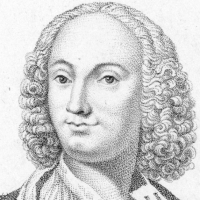
In short
Antonio Vivaldi was a Venetian composer and violinist, ordained as a priest, best known today for The Four Seasons, four violin concertos that paint spring storms, summer heat, autumn harvest, and winter ice in sound. He spent much of his career teaching at a Venice orphanage for girls, writing music for its renowned orchestra. He wrote hundreds of concertos, dozens of operas, and sacred vocal works, shaping the fast-slow-fast concerto form that later composers, including Bach, studied and borrowed from directly.
What the music sounds like
Vivaldi's concertos run about ten minutes across three movements: fast, slow, fast. The fast movements drive forward on repeating rhythmic patterns, with a full string orchestra alternating against one or two soloists who get quicker, more decorated lines. Melodies are clear and singable, harmonies bright, and pieces often open with a short, punchy theme that returns like a refrain between solo episodes. Slow movements strip back to a single melodic line over a simple accompaniment, sometimes just a bass and one chord instrument. He also wrote for less usual solo instruments, bassoon, oboe, mandolin, and gave his string writing an unmistakable snap and sparkle. Endings tend to be quick and decisive rather than drawn out. Across his sacred vocal works, expect similar energy: bright orchestral punctuation under choral or solo voices, rarely somber for long.
Where to start
- The Four Seasons "Four violin concertos, op. 8" His most famous work, four vivid concertos that describe nature scene by scene.
- Gloria in D major, RV589 A joyful choral work showing Vivaldi's vocal writing at its most celebratory.
- Bassoon Concerto in E minor, RV484 One of nearly forty bassoon concertos, showcasing his gift for unusual solo instruments.
Life
Antonio Vivaldi was born in Venice in 1678, the son of a barber turned professional violinist who likely gave him his first lessons. He trained for the priesthood and was ordained in 1703, earning the nickname "the red priest" for his hair color, though he soon stopped saying Mass regularly, reportedly due to a chest ailment.
That same year he took a post at the Ospedale della Pieta, a Venice institution that raised orphaned and abandoned girls and trained the musically gifted among them to remarkably high standards. Vivaldi worked there on and off for most of his career, as violin teacher and later musical director, writing a steady stream of concertos for its all-female orchestra and choir. Alongside this he built a reputation across Europe through published concerto collections, including The Four Seasons, part of a set called Op. 8, printed in 1725. He also composed extensively for the opera stage, traveling to stage productions in various Italian cities and taking on impresario duties himself.
By the 1730s his popularity in Venice had faded and his health was uncertain. He left for Vienna in 1740, possibly seeking imperial patronage, but the Holy Roman Emperor who might have supported him died shortly after Vivaldi's arrival. Vivaldi died in Vienna in 1741 and was buried in a modest ceremony; his enormous output was largely forgotten until manuscript collections resurfaced in the twentieth century.
Written by OrchestraFinder, reviewed September 2026.