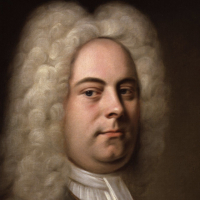
In short
Handel was a German-born composer who spent most of his career in London, writing operas, oratorios, and orchestral music for the British court and public stage. He is best known for Messiah, an oratorio about the life of Christ that has become a Christmas and Easter tradition in the US, and for Water Music and Music for the Royal Fireworks, both written for royal outdoor events. His music is tuneful, ceremonial, and built for large public occasions rather than private rooms.
What the music sounds like
Handel's orchestral music is built from clear, singable melodic lines over a steady, often march-like pulse, with strings, oboes, and sometimes trumpets and horns for outdoor or ceremonial pieces. A concerto grosso pits a small group of soloists against the full string orchestra, trading short musical phrases back and forth. Organ concertos let the organ answer the orchestra in quick, decorative runs, then step back for full ensemble passages. Pieces are typically organized in short movements, alternating slow, stately sections with fast, energetic ones, and most last only a few minutes each. Openings tend to be direct, a firm chord or a memorable tune stated right away, and endings are brisk and conclusive rather than drawn out. In vocal works like Messiah, choruses build through overlapping voice parts to big, resonant climaxes, while arias give a single singer room for ornamented, expressive lines.
Where to start
- Messiah, HWV56 His most performed work, and the piece most orchestras in this directory are staging this season.
- Water Music Suite No. 2 in D major, HWV349 Bright, brass-driven music written for a royal river party, an easy first taste of Handel's ceremonial style.
- Music for the Royal Fireworks in D major, HWV351 Loud, festive, outdoor music originally written to accompany an actual fireworks display.
Life
Handel was born in 1685 in Halle, in what is now Germany, the son of a barber-surgeon who expected him to study law. He trained instead in music, working as an organist and violinist before taking a post at the opera house in Hamburg, where he wrote his first opera. In his early twenties he traveled to Italy, absorbing the Italian styles of opera and choral writing that would shape his entire career.
In 1710 he visited London, and by 1712 he had settled there permanently. He wrote a long series of Italian operas for London audiences, including Giulio Cesare in Egitto, and worked under the patronage of the British royal family, producing occasional pieces such as Water Music, performed on the Thames for King George I in 1717, and Music for the Royal Fireworks, written for a royal celebration in 1749. He became a British subject in 1727.
As public taste for Italian opera declined, Handel turned to English-language oratorios, large-scale works for singers and orchestra performed in concert rather than staged. Messiah, composed in 1741 and first performed in Dublin in 1742, became the most famous of these. He continued composing and directing performances into his final years in London, despite losing his eyesight, and died in London in 1759. He was buried in Westminster Abbey.
Written by OrchestraFinder, reviewed September 2026.