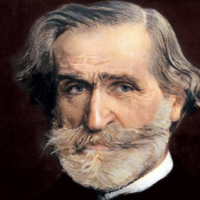
In short
Giuseppe Verdi was the dominant Italian opera composer of the nineteenth century, writing works that filled theaters across Europe and still anchor opera houses today. His melodies were built to be sung, and to be remembered after a single hearing. Beyond the theater, he wrote a Requiem of enormous scale that stands alongside his operas as one of his most performed works. His career spans the whole shift from bel canto tradition to the darker, more integrated music dramas of the later nineteenth century.
What the music sounds like
Verdi's music is built around the human voice, with orchestras that support singers rather than compete with them, at least until his later works, where the orchestra grows richer and more active. Rhythms are direct and often march-like or dance-like, driving the drama forward without lingering. Melodies tend to be singable on first hearing, frequently returning as recognizable tunes tied to a character or emotion. Choruses are used for public, communal moments, sometimes patriotic, sometimes mournful, as in the famous slaves' chorus from Nabucco. Overtures and preludes are usually brief, setting mood rather than presenting a full musical argument. Endings favor clear, often abrupt final chords over gradual fading. In his last operas, Falstaff and Otello, the orchestra becomes more continuous and conversational, closer to spoken drama set to music.
Where to start
- La traviata An intimate, fast-moving tragedy with some of Verdi's most immediately memorable melodies.
- Requiem A large-scale choral work with operatic drama, often performed in concert halls rather than churches.
- Rigoletto A tightly plotted opera showing Verdi's gift for turning a single aria into an unforgettable moment.
Life
Giuseppe Verdi was born in 1813 in the village of Le Roncole, in northern Italy, the son of an innkeeper. He showed early musical talent, studied in the nearby town of Busseto, and was later supported by a local patron to pursue formal training, though he was rejected by the Milan Conservatory as too old for admission. His early career was marked by personal loss, including the deaths of his first wife and their two children within a few years, alongside the failure of his second opera. He nearly abandoned composition before the success of Nabucco in 1842 established him as a major figure in Italian opera.
Over the following decades Verdi produced a long series of operas for major Italian and European theaters, refining a style built on strong melody, clear drama, and direct emotional appeal. Works such as Rigoletto, Il trovatore, and La traviata, all composed in the early 1850s, became central to the international opera repertoire. He continued writing for grand stages abroad, including Paris and St. Petersburg, and later returned to smaller, more concentrated dramas such as Simon Boccanegra and Aida.
In his later years Verdi wrote his Requiem in memory of the Italian writer Alessandro Manzoni, then largely withdrew from composing before returning, in his seventies and eighties, to write two further operas based on Shakespeare, Otello and Falstaff. He died in Milan in 1901, and his death prompted large public mourning in Italy, reflecting the degree to which his music had become bound up with national identity.
Written by OrchestraFinder, reviewed September 2026.