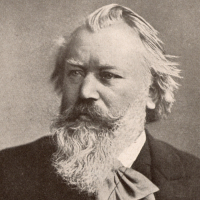
In short
Johannes Brahms was a German composer and pianist who spent decades wrestling with the legacy of Beethoven before writing his own symphonies. He wrote in almost every genre except opera, producing four symphonies, two piano concertos, a violin concerto, and a vast body of chamber and piano music. His music blends Classical structure with Romantic warmth, and it remains a cornerstone of orchestral and chamber concert programs worldwide.
What the music sounds like
Brahms's music is dense and carefully built, with themes that grow out of small motifs repeated and transformed across a movement. Rhythms often overlap in unexpected ways, a hallmark players call cross-rhythm, giving the music a rocking, slightly unsettled pulse even in slow passages. Orchestration favors warm, blended sound over bright color, with horns and lower strings often carrying the emotional weight. Symphonies typically run 35 to 45 minutes across four movements, opening with weighty, searching material and closing with music that resolves earlier tension, sometimes triumphantly, sometimes quietly. Chamber and piano works share this same thoughtful density, and many pieces draw on folk or Hungarian dance rhythms for their faster movements. Nothing feels showy for its own sake; even virtuosic passages serve the musical argument rather than display alone.
Where to start
- Symphony No. 3 in F major, Op. 90 A compact, autumnal symphony that ends quietly, showing Brahms at his most concise.
- Violin Concerto in D major, Op. 77 One of the great violin concertos, pairing lyrical melody with symphonic scale.
- Clarinet Quintet in B minor, Op. 115 A late, autumnal chamber work written for a clarinetist Brahms admired near the end of his life.
Life
Johannes Brahms was born in Hamburg, Germany, in 1833, the son of a musician who gave him his first training. He grew up playing piano in local establishments to help support his family, and by his early twenties he was traveling as an accompanist, which led to a meeting with the composer Robert Schumann in 1853. Schumann publicly declared the young Brahms a major new talent, a endorsement that both opened doors and set a heavy expectation, particularly the idea that Brahms would carry forward the symphonic tradition of Beethoven.
Brahms spent much of his life based in Vienna, where he settled permanently in 1863, working as a conductor, pianist, and composer. He was famously slow and self-critical about large orchestral forms; he did not complete his First Symphony until 1876, in his forties, after years of drafts and revisions. Once he crossed that threshold, three more symphonies followed within a decade, along with concertos, chamber works, and choral music including the German Requiem, written partly in response to personal losses.
He never married, maintained close friendships with musicians including the violinist Joseph Joachim and the Schumann family, and continued composing into his final years, including a late series of works for clarinet inspired by the clarinetist Richard Mühlfeld. Brahms died in Vienna in 1897, leaving a catalog spanning nearly every genre of his time except opera.
Written by OrchestraFinder, reviewed September 2026.