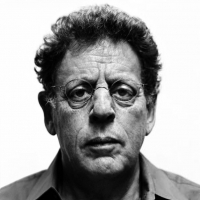
In short
Philip Glass is an American composer known for music built from short melodic patterns that repeat and slowly shift, a style often called minimalism. Starting in the 1960s he developed this approach in his own ensemble before bringing it to operas, symphonies, and film scores. His operas on Einstein, Gandhi, and Akhnaten, and scores for films like Koyaanisqatsi, brought this hypnotic, steadily pulsing sound to audiences well beyond the new music world.
What the music sounds like
Glass's music runs on steady, audible pulses, often eighth notes ticking along in an ensemble of keyboards, winds, and strings, or in the strings of an orchestra. A short pattern of notes repeats, then one note, one beat, or one chord changes almost imperceptibly, so the music feels both static and always moving. Harmonies tend to sit on simple triads that shift in unexpected sequences rather than following traditional chord progressions. Pieces can be brief, like short piano works, or expansive, like the operas that unfold over hours. Endings often arrive by simply stopping a pattern rather than building to a climax, and openings frequently drop the listener straight into a cycle already in motion. Instrumentation ranges from solo piano to amplified ensembles with electric organs to full orchestra with voices, but the fingerprint of audible repetition and gradual change stays constant throughout.
Where to start
- Glassworks, 6 pieces for chamber ensemble or piano A compact, accessible set that shows his signature repeating patterns in six short movements.
- Violin Concerto A widely performed orchestral work that pairs his pulsing style with lyrical solo violin writing.
- Akhnaten A landmark opera whose slow, ritualistic pacing and chanted texts show minimalism at operatic scale.
Life
Philip Glass was born in 1937 in Baltimore, Maryland, into a family that ran a record store, which gave him early exposure to a wide range of music. He studied at the University of Chicago and then at the Juilliard School in New York, where he trained as a composer in a fairly conventional style before his work changed direction.
A pivotal period came in the mid 1960s when he traveled to Paris to study with the teacher Nadia Boulanger and worked as a transcriber for the sitar player Ravi Shankar. Encountering non-Western rhythmic structures reshaped his sense of musical time, and on returning to New York he began writing music built from small repeating cells rather than melodies with beginnings and endings. He formed the Philip Glass Ensemble, an amplified group of keyboards and winds, to perform this new music in art galleries and small venues, since concert halls and opera houses were not yet interested.
Through the 1970s and 1980s his scale expanded dramatically, from the durational works of that early ensemble to large-scale operas and film scores. Works like Einstein on the Beach and Koyaanisqatsi brought his style to opera houses and movie theaters alike. He continued composing prolifically into the twenty-first century, producing symphonies, concertos, string quartets, and further operas, and remains active as a composer based in New York.
Written by OrchestraFinder, reviewed September 2026.